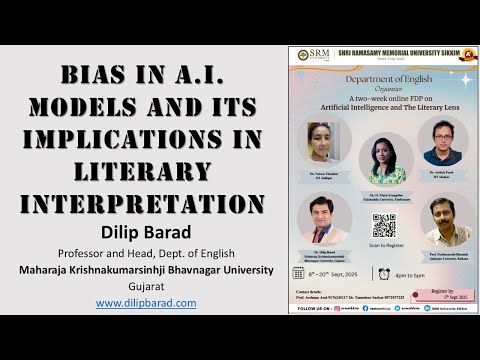
Ghosts in the Machine: Why Your AI is a 19th-Century Patriarch (and How to Fix It)
1. Introduction: The Myth of the Neutral Machine
We’ve been sold a lie: the silicon oracle is objective. In our rush to embrace the efficiency of Artificial Intelligence, we have mistaken Large Language Models (LLMs) for sterile windows into truth. We assume that because code is mathematical, it must be free from the messy, visceral prejudices of the human heart. But as Professor Dilip P. Barad reminds us, AI is not a window; it is a digital mirror.
This mirror does not reflect the world as we wish it to be; it reflects our historical blind spots, our societal fractures, and our deepest unconscious biases. When we interact with an LLM, we aren't just engaging with an algorithm; we are interacting with a distillation of human culture—and human culture is an archive of inequality. The problem is that these biases are often "unconscious," meaning we instinctively categorize people and things without even realizing we are doing so. To fix the machine, we must first recognize the cracks in the mirror. Curiously, the most effective tool for this technical audit isn't a better compiler—it is literature. By applying literary theory, we can identify the "ghosts" in the code and begin the arduous work of building a more equitable digital future.
2. Beyond Two Sides: The "Diamond" Metaphor for Critical Thinking
One of the most persistent obstacles to understanding AI bias is the hollow cliché that "every coin has two sides." Professor Barad dismisses this binary approach as obsolete and dangerous. When navigating the maze of 150+ types of unconscious bias, thinking in two dimensions is a strategy for failure.
Instead, we must adopt the "Diamond" metaphor. A diamond is multi-dimensional—it has facets that are 3D, 4D, and even 9D. Critical thinking in the AI era requires us to look at a problem from every possible angle, recognizing that there isn’t just a "pro" and "con" but a vast spectrum of cultural, historical, and social perspectives.
Shifting from "binary thinking" to "diamond thinking" is essential for identifying how mental preconditioning impacts our digital interactions. This preconditioning—beliefs instilled in us without firsthand experience—often masquerades as "knowledge." Literature helps us develop the hermeneutic (interpretive) skill to distinguish between genuine knowledge systems and these inherited belief systems. As the professor notes, the primary reason to study literary theory today is to identify the unconscious biases hidden within our socio-cultural interactions, preventing us from accepting the machine's output as a universal truth.
3. The Ghost in the Attic: AI as a 19th-Century Patriarch
To see how gender bias haunts our algorithms, we turn to the foundational feminist critique in Sandra Gilbert and Susan Gubar’s The Madwoman in the Attic (1979). The authors famously argued that patriarchal literary traditions force women into a binary: they are either the "Angel" (idealized, submissive, and trembling) or the "Monster" (hysterical, mad, and deviant).
When we prompt modern AI, these Victorian-era ghosts frequently resurface. Because AI is trained on a "patriarchal canon," it reproduces stereotypes unless explicitly corrected. However, there are signs of "Modern Correction" as models ingest 20th-century progress.
- The Patriarchal Canon (The Default): In live experiments, asking an AI to write a story about a "scientist" or "doctor" almost universally yields a male protagonist, such as "Dr. Edmund Bellam."
- The Modern Correction (Progressive Improvement): While traditional histories of literature often ignored women writers, AI models are beginning to integrate more diverse data. For instance, recent prompts for "Restoration dramatists" now successfully include Aphra Behn, a once-marginalized voice, alongside the traditional male figures of the Comedy of Manners.
- Subverting the Gothic: While earlier models might describe a Gothic heroine as a "pale, trembling girl," newer iterations sometimes yield "rebellious and brave" female leads. This is a crucial subversion of the "body shaming" often found in classical epics. While poets like Walmiki (describing Shurpanakha) or the Greek poets (describing Helen) relied on disparaging physical features to define moral character, AI can be prompted to reject this body-centric bias in favor of intellectual or qualitative descriptions.
4. Moonlight on Marble: The Aesthetic Bias of the Global North
The bias in AI isn't just about who acts; it’s about how beauty is defined. This is where the work of researchers like Timnit Gebru, Safiya Noble, and Joy Buolamwini becomes vital. Their research reveals that AI acts as a "stochastic parrot," a term coined by Gebru to describe how LLMs amplify dominant voices while effectively erasing marginalized ones—a process we might call canonical erasure.
The data proves this isn't just a theoretical concern. Buolamwini’s "Gender Shades" study revealed that commercial AI systems had error rates of less than 1% for white men but a staggering 34% for dark-skinned women. This demonstrates how AI treats "whiteness as the default."
This aesthetic bias manifests in literary prompts. When asked to "describe a beautiful woman," AI often defaults to Eurocentric metaphors. One telling response described skin with the softness of "moonlight on marble"—a clear, symbolic elevation of fair skin as the universal standard. As Gebru warns, "more data doesn't mean better data." If you feed a machine a massive volume of biased data, the scale merely amplifies the prejudice. It foregrounds Western registers of English and Eurocentric features, reinforcing colonial beauty standards under the guise of objective "beauty."
5. DeepSeek vs. ChatGPT: When Algorithms Choose Silence
Bias is not only found in what an AI says, but in what it is forbidden from saying. No algorithm is a blank slate; every tool carries the "national identity" of its creators.

This is starkly visible when comparing Western models like OpenAI’s ChatGPT with Chinese models like DeepSeek. While ChatGPT is frequently criticized for "wokeism" or a progressive liberal bias, DeepSeek demonstrates a more chilling phenomenon: algorithmic silence. When prompted with questions about sensitive histories like Tiananmen Square, DeepSeek does not just provide a different perspective; it refuses to engage entirely.
"That's beyond my current scope. Let's talk about something else."
DeepSeek masks this censorship in the language of politeness, using euphemisms like "positive developments" and "constructive answers." As Digital Humanists, we must be alarmed by these "goody-goody" words. Just as "urban beautification" in literature often masks the destruction of marginalized slums, "constructive answers" in AI often mask the erasure of historical reality.
6. The Tyrant’s Poem: How AI Interprets Power
To test the political limits of these models, researchers conducted an experiment using W.H. Auden’s poem "Epitaph on a Tyrant." The AI was prompted—in both Hindi and English—to rewrite the poem for various world leaders.

The results revealed a "glaring example" of deliberate control. The AI (specifically ChatGPT) successfully generated biting satires for Donald Trump, Vladimir Putin, and Kim Jong-un, capturing themes of "America First" and the "iron fist." However, when the same experiment was conducted on DeepSeek regarding Xi Jinping, the model defaulted to its "beyond my current scope" deflection. This shows that the "Digital Mirror" can be fogged up on purpose. When an algorithm is permitted to critique a Western "tyrant" but remains silent on a domestic leader, it ceases to be a tool and becomes a participant in state-sponsored image-making.
7. The Pushpaka Vimana Test: Myth vs. Scientific Fact
Cultural bias often surfaces in how AI labels "knowledge" versus "myth," particularly regarding Indian Knowledge Systems (IKS). A common flashpoint is the Pushpaka Vimana, the flying chariot from the Ramayana. Critics often argue that AI is biased when it labels the Vimana as "mythology" while they view it as history.
- Does the AI treat all cultural myths consistently?
- If the AI labels the Pushpaka Vimana as a "myth" but treats Greek, Mesopotamian, or Norse flying objects as "scientific possibilities," it is a clear sign of epistemological bias—the colonial habit of treating Western traditions as "universal history" and non-Western traditions as "folkloric."
- If the AI applies a consistent standard of scientific evidence to all such ancient objects across all civilizations, it is functioning as a neutral tool.
8. Conclusion: From Downloaders to Uploaders
The ultimate takeaway is that bias is unavoidable. Every critic, every historian, and every algorithm has a perspective. Our goal is not to achieve an impossible, perfect neutrality, but to make bias visible.
This is the MIND MAP of the entire blog. CLICK HERE
We must move away from the "laziness" that defines our current relationship with technology. Professor Barad issues a vital mandate for the Global South and marginalized communities: we must stop being mere "downloaders" of digital content and become "uploaders."
If our stories, our indigenous knowledge, and our specific histories are not in the data sets, the AI will continue to erase us. We cannot hide behind postcolonial arguments if we refuse to do the work of digitizing our own narratives. We must tell more stories—and tell them loudly in digital spaces—to ensure that the algorithms of the future are forced to take notice of our voices.
Can we ever achieve a true "algorithmic consciousness"? Perhaps not in the human sense. But by using literature as our debugger, we can ensure that the mirrors we build are as multi-faceted and honest as the human experience itself. The question remains: are we ready to face what the mirror shows us, or will we continue to hide behind the myth of the neutral machine?
Works Cited
Auden, W. H. "Epitaph on a Tyrant." Another Time, Random House, 1940.
Bender, Emily M., Timnit Gebru, et al. "On the Dangers of Stochastic Parrots: Can Language Models Be Too Big?" Proceedings of the 2021 ACM Conference on Fairness, Accountability, and Transparency (FAccT '21), Association for Computing Machinery, 2021, pp. 610–623.
Buolamwini, Joy, and Timnit Gebru. "Gender Shades: Intersectional Accuracy Disparities in Commercial Gender Classification." Proceedings of Machine Learning Research, vol. 81, 2018, pp. 1–15.
Gilbert, Sandra M., and Susan Gubar. The Madwoman in the Attic: The Woman Writer and the Nineteenth-Century Literary Imagination. Yale UP, 1979.
Noble, Safiya Umoja. Algorithms of Oppression: How Search Engines Reinforce Racism. NYU Press, 2018.